Why Cozy Cardio Stops Working After About Six Weeks
Quick Answer: Cozy cardio stops feeling like it is doing anything after about four to eight weeks because your body adapts to a repeated, unchanging stimulus. The same 30-minute walking pad session at the same speed costs you less effort than it did in week one, which is genuinely a sign of improved fitness even though it feels like failure. The fix is not to abandon the format but to change one variable at a time: duration, incline, pace variation, or added load. Change one thing every two to three weeks and the same cosy routine keeps working.
Week one, the 30 minutes felt like something. Week six, you finish the same session and think, was that it?
Nothing went wrong. In fact the opposite happened, which is exactly why it is so easy to misread.

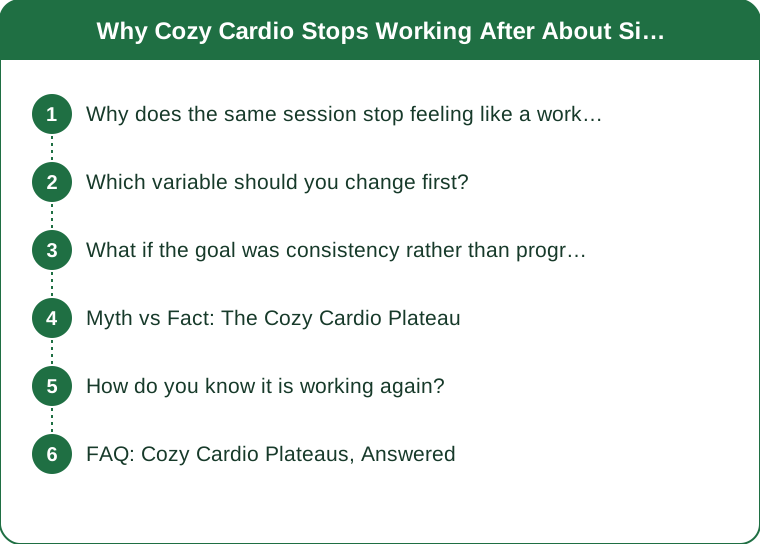
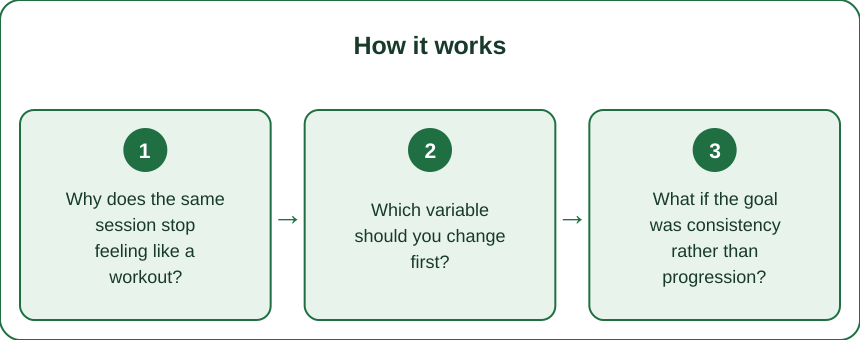
Why does the same session stop feeling like a workout?
Because your body adapts to whatever you repeat. Training adaptation is specific: do the same duration at the same intensity often enough and your cardiovascular system, muscles, and movement efficiency all improve for that exact task. The session gets easier because you got better at it.
Your efficiency improves along with your fitness. As a movement becomes familiar, you perform it with less wasted motion and less energy for the same output. Walking at 3 mph in week six genuinely costs you slightly less than the same walk in week one.
Relative intensity drops even though absolute intensity is identical. If a 3 mph walk sat at 65 percent of your maximum heart rate in week one and sits at 58 percent now, the session has quietly moved into a lower training zone without you changing anything.
And the novelty effect fades on the mental side too. Early sessions feel meaningful partly because they are new and you are proud of doing them. That freshness reliably wears off, and its absence gets misread as the workout no longer counting.
None of this means cozy cardio failed. A stimulus that produces adaptation and then stops producing more adaptation is a stimulus that worked. The mistake is treating the plateau as a verdict on the format rather than a scheduled checkpoint.
The genuine risk is quitting at exactly this moment. Six weeks is often where people abandon a routine that is one small adjustment away from working again for another two months.
Which variable should you change first?
Change duration first, because it is the least disruptive. Adding ten minutes to a 30-minute session is a 33 percent increase in total work with no change to how the session feels moment to moment. If cozy cardio’s whole appeal is that it is gentle, this preserves that completely.
Add incline second. On a walking pad or treadmill, moving from flat to a 3 to 5 percent incline raises the energy cost substantially at the same speed - it is the single biggest change available for the smallest change in perceived pleasantness. Uphill walking also loads the calves and glutes more, which flat walking barely touches.
Add pace variation third. Alternate three minutes easy with two minutes brisk for the middle 20 minutes of your session. Varying intensity within a session reintroduces a stimulus your steady-state routine has stopped providing, without turning the whole thing into a hard workout.
Add load fourth, and carefully. A weighted vest of around 5 to 10 percent of body weight increases the cost of the same walk. Start with the lowest weight available and short durations, and skip this entirely if you have knee, hip, or back issues - this is general information, not medical advice.
Change one thing at a time and hold it for two to three weeks. Changing everything at once means you cannot tell what helped, and it usually makes the session unpleasant enough that you stop doing it.
And keep one session a week completely unchanged. The easy, familiar, genuinely cosy version is what makes the habit survive bad weeks. Progressing every single session is how a gentle routine turns into another thing you dread.
What if the goal was consistency rather than progression?
Then the plateau may not be a problem at all. Maintaining a habit that keeps you moving daily has real value for cardiovascular health, mood, and sleep even if it stops driving new adaptations. Not every routine needs to keep getting harder.
Be honest about which goal you are actually chasing. If the aim is fat loss or measurable fitness change, a plateau does need addressing. If the aim is daily movement and a mental reset, the session working at a lower relative intensity is fine.
Maintenance requires less than people assume. Holding on to a level of fitness generally takes less volume than building it did, so an unchanging routine can preserve most of what you gained.
Watch for the goal quietly shifting under you. Many people start cozy cardio for gentleness, then start expecting body composition changes from it, then conclude it does not work. The routine did not change - the standard it was being judged against did.
If the goal has changed, the routine should too. That does not mean abandoning cosy for brutal. It means the four adjustments above, or adding two short strength sessions a week alongside the walking rather than instead of it.
And separate the habit from the intensity. The valuable, hard-won part is that you show up. Intensity is comparatively easy to change once showing up is automatic.

Myth vs Fact: The Cozy Cardio Plateau
Myth: The plateau means cozy cardio never really worked. Fact: it means it worked. Adaptation is the mechanism by which a stimulus stops feeling hard, and you only reach it by having trained consistently.
Myth: You need to switch to high intensity now. Fact: adding ten minutes or a 3 percent incline is enough to restart progress. Jumping to intervals you dread is the most common way a sustainable habit dies.
Myth: If your tracker says fewer calories, you are doing less. Fact: wearable calorie estimates carry substantial error and often get less flattering as your resting heart rate improves. Use them for trends, not verdicts.
Myth: More days per week is always the answer. Fact: adding frequency to an already daily routine is not possible, and for most people duration or incline changes are easier to sustain than squeezing in extra sessions.
Myth: A plateau means you should take a long break. Fact: a week off will make the session feel harder again, but only by reducing your fitness. That is not the kind of harder you want.
Myth: Cozy cardio is only for beginners. Fact: low-intensity steady work is a staple of serious endurance training. What changes with fitness is the duration and the terrain, not the concept.
How do you know it is working again?
Use a fixed benchmark session once a month. Same duration, same incline, same speed. Note your average heart rate and how hard it felt on a one to ten scale. If both drop over time, you are getting fitter regardless of what the scale says.
Track a recovery marker rather than a burn marker. How quickly your heart rate falls in the two minutes after you finish is a more useful signal than an estimated calorie figure, and it is free to check.
Notice the non-training evidence. Stairs that used to require a pause, a hill on your usual route that no longer registers, carrying shopping without changing your breathing pattern. These are the outcomes that matter and they rarely appear in an app.
Give any change three weeks before judging it. Cardiovascular adaptations to a new stimulus take a few weeks to show up, and week one of anything new always feels worse before it feels better.
And expect a new plateau in another six to eight weeks. That is not failure either. It is the rhythm of training: adapt, adjust, adapt again. Plan the next small change instead of being surprised by it.
FAQ: Cozy Cardio Plateaus, Answered
Why does cozy cardio feel easier but produce less?
Because your body adapted. The same walk at the same speed now sits at a lower percentage of your maximum capacity and costs you less energy, so it produces less of a training stimulus even though you are doing exactly the same thing.
How do I make cozy cardio harder without making it unpleasant?
Add ten minutes of duration first, then a 3 to 5 percent incline. Both raise the total work substantially while keeping the session’s feel and pace almost unchanged.
Should I switch to HIIT if cozy cardio stopped working?
Not necessarily, and not as a first move. Adjusting duration, incline, or pace variation restarts progress while keeping the habit you have already built. Swapping to something you dread is the fastest route back to doing nothing.
How often should I change my routine?
Hold each change for two to three weeks before adding another, and keep at least one weekly session completely unchanged so the routine stays sustainable on low-energy days.
TL;DR:
- Cozy cardio plateaus at four to eight weeks because your body adapts and the same session becomes cheaper to perform - that is success, not failure.
- Change one variable at a time: duration first, then incline, then pace variation, then light added load.
- Hold each change two to three weeks, and keep one unchanged easy session weekly so the habit survives bad days.
- Judge progress with a fixed monthly benchmark session and recovery signals, not with wearable calorie estimates.
- If the goal is consistency rather than progression, a plateau may not need fixing at all - just be clear about which goal you are measuring against.
The routine did not stop working. It finished the job you gave it and is waiting for the next one.
See It in Motion
Seen here: Yoga Jogger Sweatpants with Pockets — shop it on bubblelime.com
Keep Reading
This article is for general informational and styling purposes only. Fit, sizing, and product availability may vary.