Why Cozy Cardio Gets Harder When the Evenings Get Darker
Quick Answer: Cozy cardio gets harder in late summer because the light cue that used to start your session disappears. Your routine was anchored to it being bright at 7pm, not to the clock. Rebuild the anchor around something that does not change with the season — a specific show, a lamp you switch on, the moment you finish dinner — and the routine survives the shift.
You did it four evenings a week for two months. It was easy. It was, genuinely, the nicest part of the day.
Then somewhere in the last two weeks it started slipping. Three times a week, then twice, then a stretch of days where you meant to and simply did not.
Nothing about the routine changed. The room did.
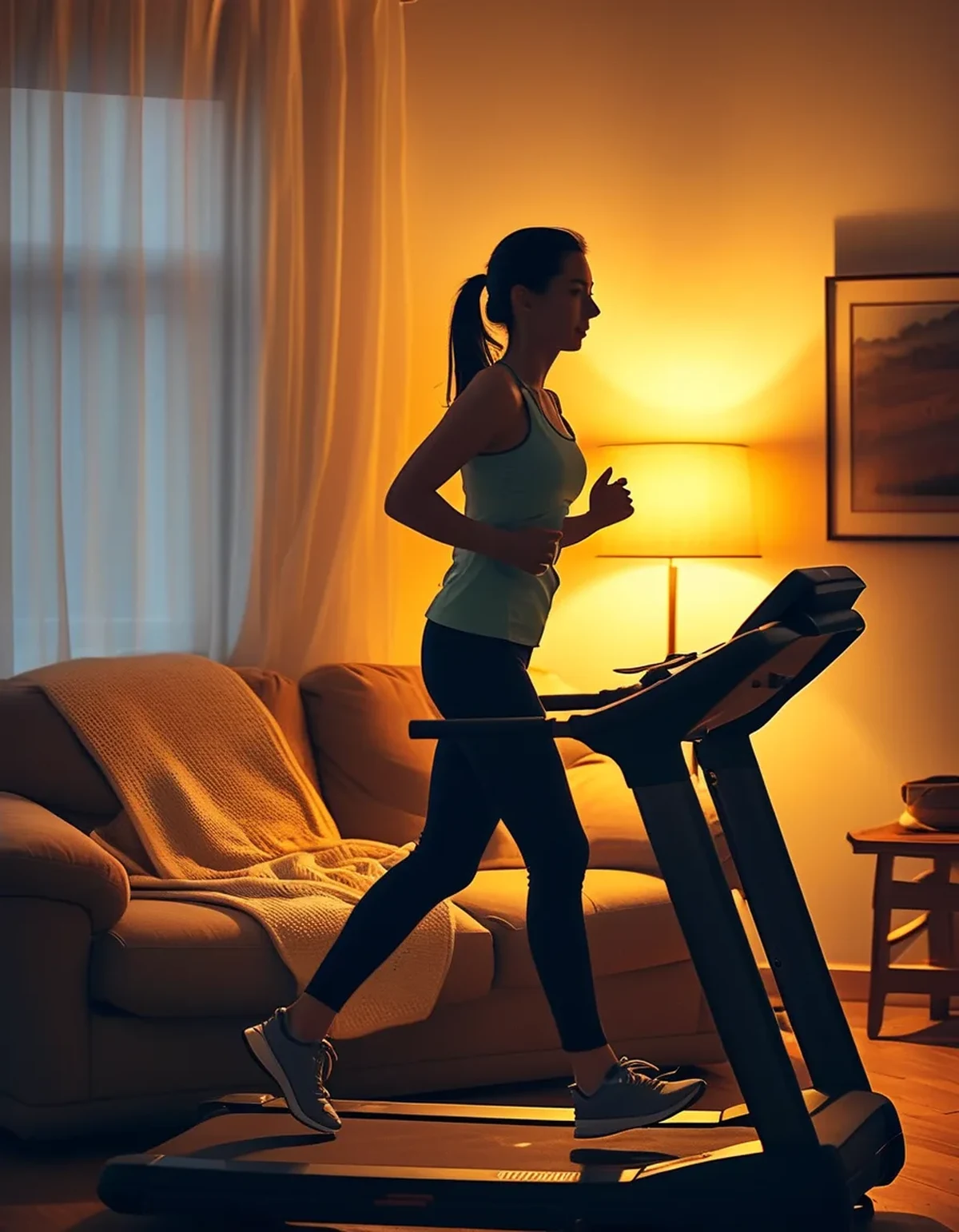
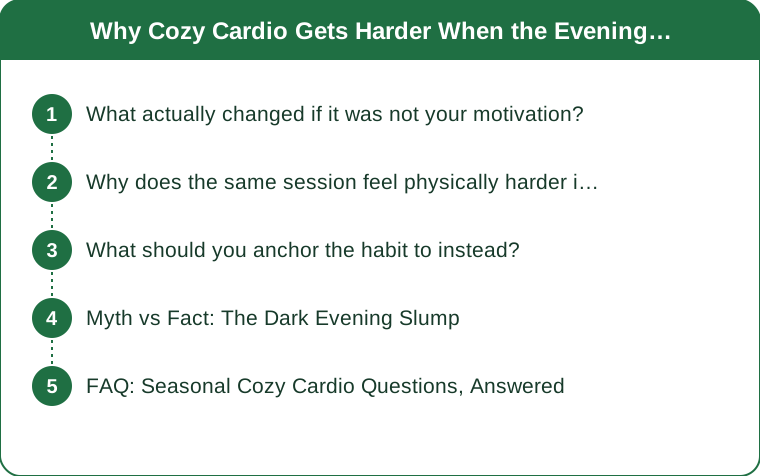
What actually changed if it was not your motivation?
The light. Specifically, the light at the hour you used to start.
Through July, sunset in most of the northern US is somewhere around 8:20pm. By late August it has moved to roughly 7:30, and by the third week of September it is closer to 7:00. That is more than an hour of evening light gone in six weeks, and it goes fastest in exactly this stretch.
Here is why that matters more than it sounds. Most people who build an evening habit think they anchored it to a time. They did not — they anchored it to a state of the room. It was bright, the day still felt open, and starting something felt natural.
When the room is dim at the same clock time, your body reads it as later than it is. Melatonin release begins in response to falling light, and the subjective sense of “the day is winding down” arrives earlier. You are not less disciplined. Your internal clock has been handed different information.
The other half is behavioural. A habit is a cue plus a routine. If the cue disappears, the routine does not fire, no matter how well established it felt. The cue you had was free and reliable all summer, which is precisely why you never noticed you were depending on it.
That is good news, because a missing cue is a much easier problem to solve than missing motivation.
Why does the same session feel physically harder in the dark?
It is not only in your head, though a good part of it is.
Perceived effort rises in dim light. The same walking pace at the same incline reliably feels like more work in a dark room than a bright one. Environmental brightness is one of the inputs your brain uses to set arousal, and lower arousal means the same physical effort registers as heavier.
Your core temperature is on the way down. Body temperature peaks in the late afternoon and declines through the evening. As the evening effectively starts earlier — dark room, wound-down feeling — you are more likely to be starting your session on the falling part of that curve rather than near the top of it.
The room itself is cooler. Late-August evenings drop faster than mid-summer ones. Starting cold means a longer, less comfortable first ten minutes, and the first ten minutes are the entire battle in a habit like this.
Three practical corrections:
- Turn the lights up, not down. This feels contrary to the whole cozy premise, but bright during the session and dim afterwards is the sequence that works. Use a bright overhead or work lamp for the walk, then switch to the warm lamp when you are done.
- Start five to ten minutes earlier than you think you need to. Not to squeeze in more — to catch the tail of your temperature peak.
- Warm the room or warm yourself first. A hot drink before rather than after, or two minutes of moving before you get on the machine, removes most of the cold-start friction.
The cozy part is not the reward for finishing. Deployed correctly it is the thing that gets you started.
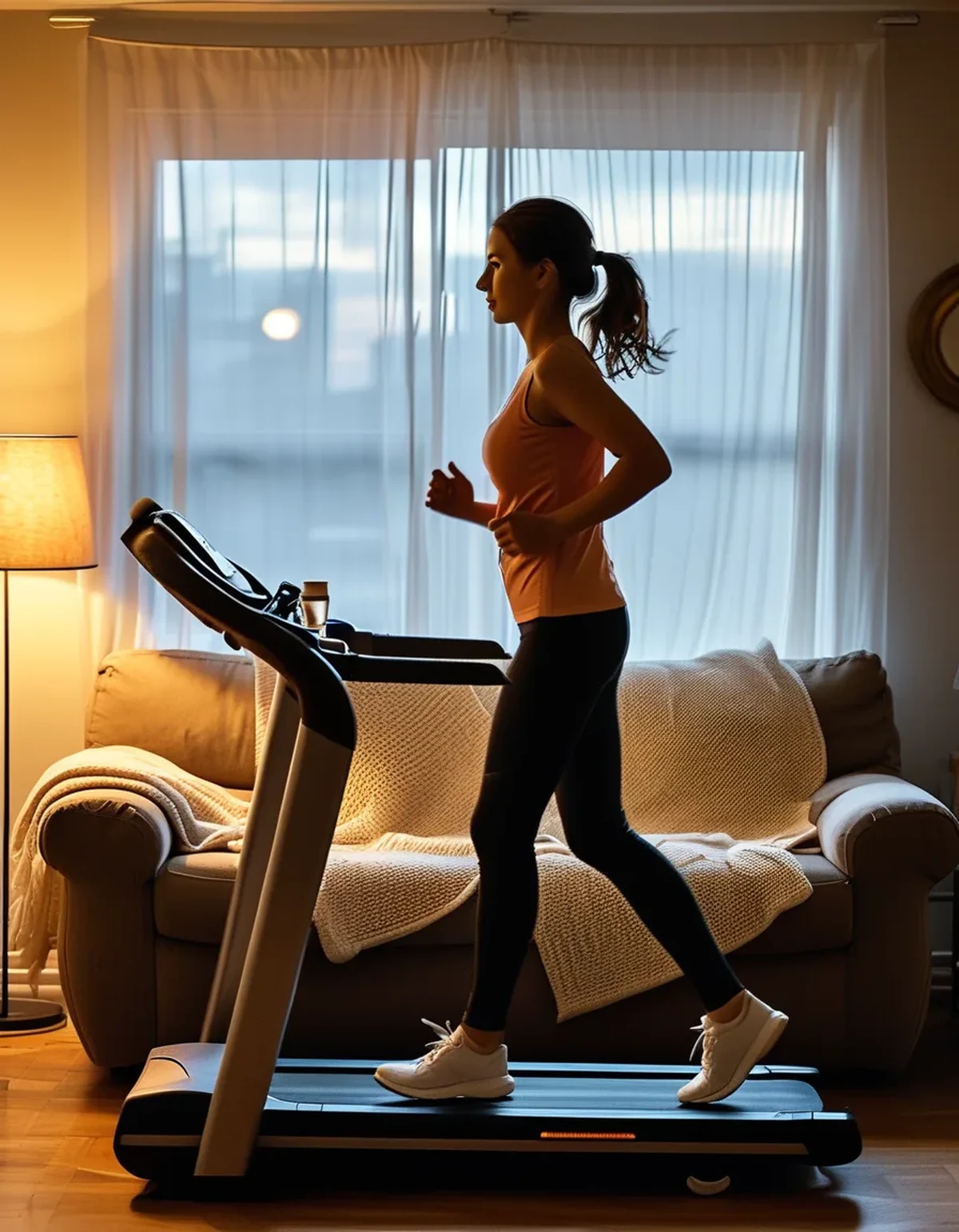
What should you anchor the habit to instead?
Anything that does not move with the calendar. The best anchors are things you already do without deciding to.
Anchor to a meal, not a time. “I walk while the kettle boils and for two episodes after dinner” is a cue that works in December exactly as well as it works in July. “I walk at 7” quietly means “I walk when it is light out.”
Anchor to a piece of media. One specific show, one specific podcast, only watched or listened to while you are moving. This is unusually effective because it creates a small genuine incentive — you cannot find out what happens unless you are walking. Choose something with episodes of roughly the length you want your session to be.
Anchor to a physical action. Switching on a particular lamp, unrolling the mat, putting on one specific pair of socks. It sounds trivial. Small physical rituals are effective precisely because they require no decision.
Anchor to another person. A message to a friend when you start. Not a workout partner, just a witness.
One thing to avoid: do not anchor to “when I feel like it after dinner.” Feeling like it was never the mechanism. The light was doing that work for you all summer, and you are now finding out what the routine looks like without an assistant.
Myth vs Fact: The Dark Evening Slump
Myth: You need more discipline in autumn. Fact: You need a different cue. Discipline is what you spend when the structure fails, and it is a finite resource. People who keep evening routines through winter almost never have more willpower — they have an anchor that does not depend on daylight.
Myth: If you are tired at 7pm you should just move the session to the morning. Fact: Sometimes true, often a trap. Moving a habit to a completely new slot means rebuilding it from zero, and you will be doing that in the hardest season. Try fixing the cue in the existing slot for two weeks first. Move only if that genuinely fails.
Myth: Cozy cardio is too easy to be worth protecting. Fact: Low-intensity work done consistently across a whole autumn beats intense work abandoned in October, on every measure that matters. The value is entirely in the streak, which is exactly why a cue failure is worth taking seriously.
Myth: You should push harder in winter to compensate for being less active. Fact: Raising intensity at the moment adherence is fragile is how routines die. Keep the intensity where it is. Protect the frequency.
FAQ: Seasonal Cozy Cardio Questions, Answered
Should I use a SAD lamp during my session?
A bright light box in front of you while you walk is a reasonable combination if your evenings feel genuinely flat — you get the light exposure without needing a separate sitting session. Be aware that bright light late in the evening can push your body clock later and affect sleep, so keep it to earlier evening rather than the hour before bed.
Is 20 minutes still worth it if I used to do 45?
Yes, and shortening deliberately is a much better response than skipping. A 20-minute session keeps the cue alive, keeps the habit chain unbroken, and is far easier to start on a low-energy evening. You can rebuild the duration in spring. You cannot rebuild a habit you stopped doing in October.
Why do I feel more like snacking after evening sessions now?
Partly the cooler room — mild cold exposure nudges appetite up — and partly the earlier wind-down cue making the evening feel longer. If it is bothering you, having your session closer to dinner rather than well after it usually resolves it without needing any deliberate restraint.
TL;DR:
- The routine is failing because the light cue disappeared, not because your motivation did
- Sunset moves back over an hour between mid-July and mid-September, and fastest right now
- Brighten the room during the session and save the dim, warm lighting for afterwards
- Re-anchor to something seasonless: a meal, a specific show, a lamp, a text to a friend
- Shorten the session before you skip it — frequency is the thing worth protecting
The version of this routine that works in February is a different machine from the one that worked in July. It is worth building now, in late August, while the habit is still mostly intact and you only have to repair one part of it.
See It in Motion
Seen here: High Waist Jogger Sweatpants with Pockets — shop it on bubblelime.com
Keep Reading
This article is for general informational and styling purposes only. Fit, sizing, and product availability may vary.