How Long Should a Cozy Cardio Session Actually Be?
Quick Answer: For consistency and mood, 20 minutes is the whole answer and going longer adds almost nothing. For cardiovascular fitness, you need 30 to 45 minutes per session to accumulate the 150 weekly minutes that actually shift resting heart rate. For meaningful body composition change, duration is the wrong lever entirely - frequency is. The most common mistake is picking a duration from how long the show is, then quietly resenting the session when the show is 52 minutes.
Cozy cardio has no coach telling you when to stop. That is most of its appeal and the entire source of the question.
So the length gets decided by something arbitrary - one episode, the length of a playlist, however long the candle stays interesting - and then it silently becomes the standard. Forty-two minutes because that is a streaming episode. Sixty because it sounds like a real workout.
Neither number came from anything. Here is where the real numbers come from.

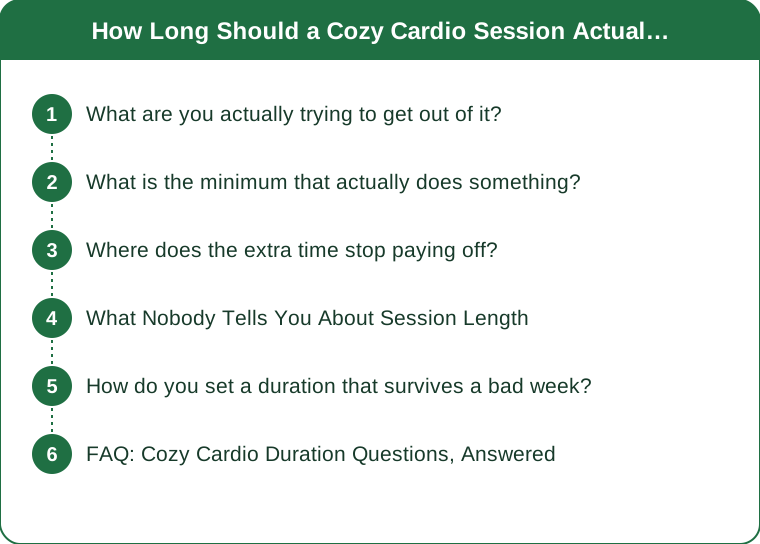
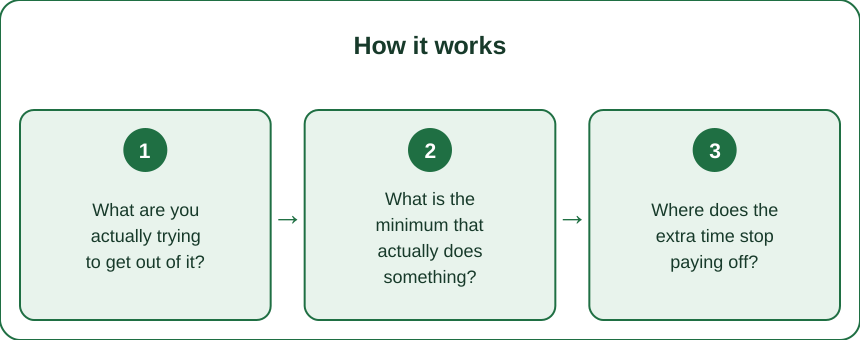
What are you actually trying to get out of it?
This is the question that decides the duration, and skipping it is why the answer feels so slippery.
Cozy cardio delivers three different things, and they have three different dose-response curves:
1. Mood, stress and consistency. This is what most people are really there for, whether or not they would say so. The good news is that it is the fastest-saturating benefit of the three. The mood effect of low-intensity rhythmic movement shows up in the first ten minutes and is essentially fully banked by twenty. Minute 45 does not feel twice as good as minute 20 - it usually feels slightly worse, because by then you are watching the clock.
2. Cardiovascular fitness. This one is genuinely duration-dependent. Zone 2-ish effort improves aerobic capacity through accumulated time, and the accumulation is what matters. This is where the standard 150 minutes of moderate activity per week comes from, and it is the only one of the three goals where a 20-minute session is meaningfully short.
3. Body composition. Here duration is close to a red herring. A cozy cardio session burns modestly - a walking-pace session runs in the low-to-mid hundreds of calories per hour depending on your size and speed - and the body is very good at quietly compensating for it with reduced movement later in the day. Doubling the session does not double the deficit.
So before you set a timer: which one are you buying? Because if it is mood and consistency, you have been overpaying, possibly for months.
What is the minimum that actually does something?
Ten minutes, and that is not a consolation prize.
Ten minutes of low-intensity movement is enough to raise heart rate above resting, shift you out of a seated posture, and produce a measurable mood change. It also counts toward weekly activity totals - the old idea that exercise had to come in ten-minute-minimum bouts to count was dropped from major activity guidelines years ago. All movement counts, in whatever pieces you do it.
What ten minutes does not do is build meaningful aerobic fitness on its own, unless you do it often. Ten minutes five days a week is 50 minutes - real, but a third of the standard target.
Where the ten-minute session earns its keep is on the days you were going to skip. And this is the part that matters more than the physiology: the biggest predictor of cozy cardio working is not session length, it is whether the habit survives a bad week. A ten-minute floor that you never break beats a forty-minute standard you abandon every time the week goes sideways.
A practical structure that holds up:
- Floor: 10 minutes. Non-negotiable, for bad days. Never allowed to become zero.
- Default: 20 to 25 minutes. The everyday session.
- Long: 40 to 45 minutes. Once or twice a week, when it genuinely appeals.
The floor is the load-bearing part. Everything else is optional.
Where does the extra time stop paying off?
There are three fairly clear plateaus, and knowing where they sit stops you chasing minutes that do not exist.
Around 20 minutes: the mood plateau. The stress-reduction and mental-clarity return flattens hard. Minutes 20 to 40 are not worthless, but they are worth dramatically less per minute than 0 to 20. If your only goal is to feel better, you can genuinely stop.
Around 45 minutes: the enjoyment plateau. This is the one nobody warns you about, and it is the one that ends the habit. Past roughly 45 minutes at low intensity in your own home, the session stops being pleasant and becomes an obligation you happen to be doing in slippers. The whole mechanism of cozy cardio is that it is nice enough to repeat. A duration that makes it not-nice has broken the machine, no matter how good the numbers look.
Around 60 minutes: the compensation plateau. Longer low-intensity sessions reliably produce lower unconscious activity for the rest of the day - fewer steps, more sitting, more time on the sofa afterwards. You did an hour and your daily total barely moved. This is normal physiology, not a personal failing, and it is the reason very long low-intensity sessions are an inefficient tool for body composition.
The pattern across all three: more is better until roughly 20 minutes, neutral to 45, and mildly counterproductive past 60.

What Nobody Tells You About Session Length
The duration you choose is a promise to your future self, and most people write a cheque they cannot cash.
A few things that only become obvious after a few months:
The number you pick becomes the definition of a real session. Set 45 minutes as your standard and a 20-minute day stops counting - not officially, just in your head. You will do 20, feel like you failed, and skip tomorrow. This is the single most common way a cozy cardio habit dies, and it is caused entirely by the standard being too high.
Long sessions are less consistent, not more. A 45-minute session requires a 45-minute hole in your day, and those are rarer than you think in September. Twenty-minute sessions fit in places 45-minute sessions cannot, which means over a month the shorter standard usually accumulates more total minutes. Twenty minutes six days a week is 120. Forty-five minutes twice a week, because that is all you could fit, is 90.
Two 15s beat one 30 for adherence and tie it for benefit. Split sessions are not a compromise. Two short bouts produce comparable cardiovascular benefit to one continuous one, and they are far easier to place in a day.
The setup tax is real and it is fixed. Blanket, candle, drink, screen, shoes - that is five to ten minutes regardless of session length. On a 10-minute session that overhead is brutal, which is a genuine argument for a 20-minute default rather than a 10-minute one on normal days.
Your enjoyment is data. If you are checking the time at minute 12 every session, the duration is wrong. Not your discipline. The duration.
How do you set a duration that survives a bad week?
Build the schedule around what a hard week looks like, not what a good one does. Good weeks take care of themselves.
Start from your weekly total, not the session. Decide you want, say, 120 minutes a week. Then divide by the number of days you will realistically show up - not the number you would like to. Six realistic days means 20-minute sessions. Four means 30.
Set a floor and a ceiling, not a target. Floor 10 minutes, ceiling 45. Anything in between is a completed session, full stop, no internal editorialising.
Attach it to something fixed rather than something free. ‘After I make coffee’ survives a busy week. ‘At 7am’ does not, because 7am gets taken. The late-August schedule reset - school starting, earlier mornings, darker evenings - is exactly when time-anchored habits break and event-anchored ones hold.
Let the season shift it. As mornings cool and daylight shortens, most people naturally drift longer and slower. That is fine. Let the ceiling rise to 45 without letting the floor rise at all.
Review by the month, not the day. One 12-minute session tells you nothing. Four weeks of totals tells you whether the duration you picked is one you actually do.
FAQ: Cozy Cardio Duration Questions, Answered
Is 20 minutes of cozy cardio enough to count as exercise?
Yes, genuinely. Twenty minutes of light-to-moderate movement counts toward activity guidelines, produces a real mood effect, and if you do it five or six days a week it puts you close to standard weekly recommendations. The word ‘enough’ is doing a lot of hidden work in that question, though - enough for what? Enough for health and consistency, easily. Enough as your only training if the goal is strength, no.
Should I do longer sessions on weekends?
Only if you want to. There is no physiological requirement for a long weekend session, and the main risk is that it recalibrates your sense of what a real workout is, which makes the Tuesday 20-minute version feel like less. If long weekend sessions genuinely appeal, do them because they are enjoyable, not because you are catching up.
Does it matter if I break it into two short sessions?
No, and it may be better. Accumulated activity produces comparable cardiovascular benefit to continuous activity, and two 15-minute bouts fit into a working day far more easily than one 30. The only real cost is the setup tax twice over - which for cozy cardio, with its blankets and candles and drinks, is not nothing.
This is general information, not medical advice. If you have a heart condition or you are returning to activity after illness or a break, talk to your doctor about appropriate duration and intensity.
TL;DR:
- 20 minutes is the honest default. Mood and stress benefits are essentially fully banked by then.
- Only cardiovascular fitness genuinely needs more - 30 to 45 minutes, aiming at roughly 150 weekly minutes.
- Past 45 minutes it stops being pleasant, and past 60 your body quietly compensates by moving less all day.
- Set a floor of 10 minutes and a ceiling of 45, and treat anything in between as a complete session.
- Frequency beats duration every time. Twenty minutes six days a week outruns forty-five twice.
The reason the duration question feels hard is that it is really a goals question wearing a stopwatch. Answer that one, and the timer sets itself.
See It in Motion
Seen here: High Waist Wide Leg Yoga Pants with Pockets — shop it on bubblelime.com
Keep Reading
This article is for general informational and styling purposes only. Fit, sizing, and product availability may vary.