Cozy Cardio With a Toddler in the Room
Quick Answer: Redesign the session around interruption, not duration. Anything that requires you to be lying down, still, or uninterrupted for 20 minutes will fail. What survives is standing, upright, low-equipment movement you can pause instantly and resume: walking on the spot, marching, step-ups on a bottom stair, standing strength with light weights. Move the session to a time you can defend, accept that 3 blocks of 8 minutes beats one 25-minute block that never happens, and childproof the space so a pause does not become an emergency. The candle stays unlit until they are asleep.
The original pitch for cozy cardio was low pressure. A toddler is the ultimate test of whether you meant it.

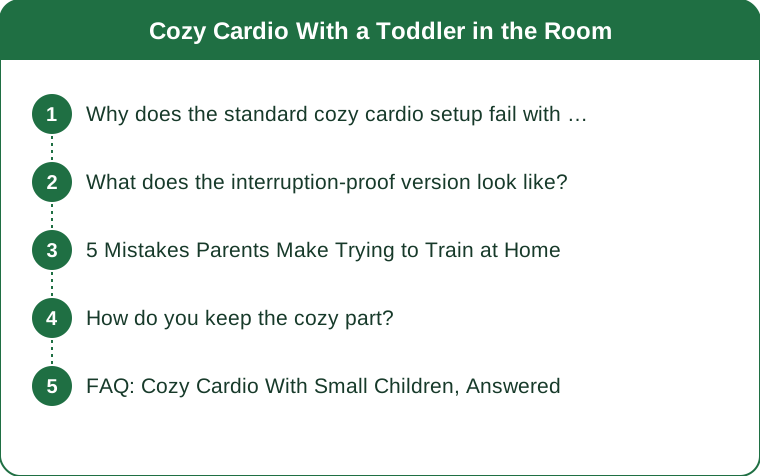
Why does the standard cozy cardio setup fail with a small child?
Because almost every element of it assumes uninterrupted time and floor-level stillness, and a toddler removes both.
The floor is not yours. Mat work, stretching, and anything lying down is an open invitation - a parent lying on the floor is a climbing frame. This is not a discipline problem, it is a two-year-old correctly identifying an opportunity.
Equipment becomes a hazard. Dumbbells at floor level, resistance bands, and a walking pad are all genuinely dangerous around a small child. A walking pad in particular - moving belts and small fingers are a known injury combination, and the belt gap is exactly the wrong size.
Candles are out. Obviously, and worth stating because the aesthetic is half the appeal for a lot of people.
The pause is guaranteed. You will stop. Something will be spilled, someone will need lifting, a snack will be requested. A format that treats a pause as a failure will be abandoned within a week.
The reframe that makes it work: the goal shifts from a session to accumulated minutes. Three eight-minute blocks across a morning is a genuinely useful amount of movement, and it is a format that a toddler cannot break because there is nothing to break.
One thing that improves unexpectedly: small children love copying. Marching, stepping, and stretching are frequently joined rather than interrupted, and a toddler doing star jumps next to you is an easier ten minutes than a toddler wondering why you are ignoring them. Building them in beats defending against them, at least some of the time.
What does the interruption-proof version look like?
Movements that work - all standing, all instantly pausable:
- Walking on the spot or around the room. The core of it. Lift the knees a little higher than feels natural and it becomes real work.
- Marching with arm movements, which raises heart rate without any impact or noise.
- Step-ups on the bottom stair. Excellent, requires nothing, and easy to abandon mid-set.
- Standing strength: squats, calf raises, wall push-ups, standing rows with a band anchored at door height - anchored well above toddler reach.
- Light dumbbells if they are held, never put down. Between sets they go straight back on a high shelf, not on the floor.
- Dancing. Genuinely the highest-compliance option with a toddler in the room, because they join in.
Movements to save for nap time or bedtime:
- Anything on the floor - mat work, stretching, core work, yoga
- Walking pad use
- Anything with weights on the ground
The three-block structure:
- Block 1, on waking or after breakfast: 8 to 10 minutes. Walking on the spot plus a standing strength circuit.
- Block 2, mid-morning or during a contained activity: 8 to 10 minutes.
- Block 3, after bedtime: whatever you want. This is where the mat, the candle, and the actual cozy part live.
Total: 25 to 30 minutes, which is a good day for anyone, achieved without ever needing an uninterrupted stretch.
Set it up so pausing costs nothing. Shoes on, nothing to lay out, no app to start. If restarting takes more than five seconds, you will not restart.

5 Mistakes Parents Make Trying to Train at Home
Mistake 1: Waiting for nap time every day. Naps are unreliable, they shrink, and one bad week takes the whole routine with them. Nap time is a bonus block, not the plan. Anything that only works when a toddler sleeps predictably is a plan built on sand.
Mistake 2: Leaving equipment out between blocks. The convenience is real and so is the risk. Weights, bands, and rollers go up high the moment a block ends. A resistance band anchored low is a strangulation risk and a band that snaps under a child’s pull is a face injury - both are worth being strict about.
Mistake 3: Treating a joined-in session as a ruined one. A toddler copying squats is not an interruption, it is a different session. Fighting it produces frustration for both of you; going with it produces ten more minutes.
Mistake 4: Choosing a format with momentum. Follow-along videos, timed circuits, and anything with a countdown all punish pausing. Untimed, self-paced movement is the right structure - you rejoin exactly where you left.
Mistake 5: Judging the day by whether the full session happened. The metric is total minutes moved, not sessions completed. Someone who accumulated 22 broken minutes had a better day than someone who planned 30 and did none - and only one of those two feels good about it.
How do you keep the cozy part?
The appeal of this approach was never the exercise physiology. It was that movement stopped feeling like an obligation, and that is worth protecting.
Split the ritual from the movement. The candle, the coffee, the podcast, the low lighting - those belong to the evening block, after bedtime, when they are actually possible. During the day, the movement happens without the ritual, and that is a fair trade rather than a loss.
Keep one sensory thing that works in daylight. Usually the audio - a podcast or a playlist that is yours, in one earbud so you can still hear the room. It is a small thing and it does most of the work of making a session feel like a break rather than a chore.
Protect the evening block properly. Twenty minutes after bedtime, with the actual setup, two or three times a week. This is the session that keeps the whole thing feeling good, and it tends to be the first thing sacrificed to tidying up.
Lower the bar deliberately and out loud. The floor version - the smallest thing that still counts - should be something like five minutes of walking on the spot. Deciding that in advance is what stops a chaotic day becoming a missed day.
Accept the season. A phase with a toddler at home is not the phase for building a lot of fitness, and expecting it to be produces a background sense of failure that outlasts the phase. Maintaining the habit is the goal; the capacity to build comes back when the days get more predictable.
A note on the walking pad, since it is the signature piece of equipment here: it is genuinely useful and genuinely a hazard with small children. Use it only when they are asleep or out, unplug it and store it upright if possible, and never allow it to become normal for them to be near it running. This is one where the standard safety advice from manufacturers is not overcautious.
FAQ: Cozy Cardio With Small Children, Answered
Is broken-up exercise as good as one continuous session?
For general health and activity accumulation, short bouts spread through the day compare well with one longer session. For building endurance specifically, longer continuous work has advantages - but that is not what this phase is for.
How do I stop feeling like I am doing a rubbish version of exercise?
By changing the comparison. The alternative is not a perfect 45-minute session; it is nothing. Twenty-five accumulated minutes on a chaotic day is a good outcome by any honest measure.
What about doing it while babywearing?
Walking with a baby in a carrier is fine and often lovely, within the carrier’s guidance. Avoid anything with impact, bending forward, or overhead movement while wearing, and be aware your balance and centre of gravity are changed.
My toddler wants to be picked up the whole time. Is that just the workout?
Carrying a toddler is genuine load - and it is also one-sided and repetitive. It counts as activity, but rotate sides and do not treat it as a substitute for anything that loads you symmetrically.
When can I get back to proper sessions?
When sleep and days become predictable, which varies enormously. The useful thing is that a maintained habit restarts easily, and an abandoned one has to be built from zero.
TL;DR:
- Design for interruption, not duration - standing, upright, instantly pausable movement that needs no setup.
- Three blocks of 8 to 10 minutes beats one 25-minute block that never happens.
- Nap time is a bonus, not the plan. A routine that depends on reliable naps collapses in one bad week.
- Equipment goes up high between blocks, and the walking pad only runs when they are asleep or out.
- Move the candle and the ritual to the evening block - that is the session that keeps this feeling like a break rather than a chore.
A toddler copying your squats is not a ruined session. It is a different one, and it lasts longer.
See It in Motion
Seen here: High Waist Wide Leg Yoga Pants with Pockets — shop it on bubblelime.com
Keep Reading
This article is for general informational and styling purposes only. Fit, sizing, and product availability may vary.