Your Cozy Cardio Setup Was Built for Summer. Here Is What Breaks in Autumn
Quick Answer: Cozy cardio routines usually fail in autumn for three practical reasons, none of them motivational: the room is cold enough that starting is genuinely unpleasant, the light you were using to wake up has disappeared, and the outfit that worked at 24 degrees does not work at 16. Warming the space before you get up, adding a light source, and switching to a layer you can remove five minutes in fixes most of it.
In July you rolled out of bed, put a show on, and walked for thirty minutes before you were properly awake.
In late September the same routine takes an act of will. Everyone assumes that is discipline slipping. Mostly it is a room that is now 16 degrees and a window that is still dark.

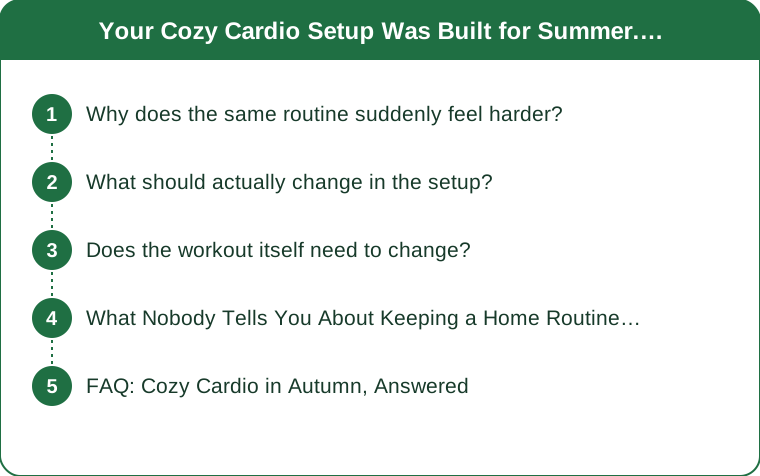
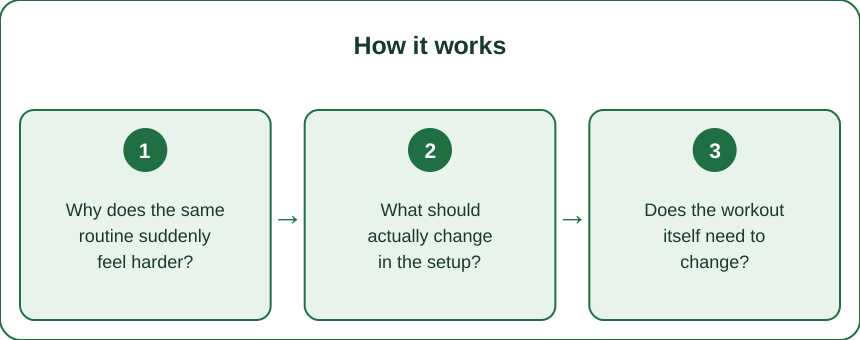
Why does the same routine suddenly feel harder?
Three changes happen at once, and they compound.
Your body’s willingness to start moving is temperature-dependent. In a cold room, the initial minutes of low-intensity movement feel worse because you are working with cold muscles and constricted peripheral blood flow. The exact same walk that felt easy at 24 degrees feels like effort at 16 for the first five to ten minutes.
Light disappeared. Morning light is a primary signal for the circadian system, and in most of the northern hemisphere the sunrise moves substantially later through September and October. A 6:30am start that was in daylight in July is in darkness by mid-October. That changes alertness at the moment you are asking yourself to begin.
Your setup was optimised for conditions that no longer exist. The open window, the light layer, the cold drink - each was solving a summer problem. In autumn they create problems.
Why this matters more for cozy cardio than for other formats: the whole premise is that the barrier to starting is near zero. Gym-based routines have a built-in commitment mechanism - you travelled there. Cozy cardio’s advantage is also its fragility: when starting stops being frictionless, there is nothing else holding it up.
The reframe that helps: you have not lost discipline. Your environment changed and your setup did not. That is a solvable problem, and it takes about twenty minutes of preparation rather than a motivational reset.
What should actually change in the setup?
Four adjustments, in order of how much difference they make.
1. Make the room warm before you are in it. The highest-impact change. If you have a heating timer, setting it to come on 30-45 minutes before you get up removes the single biggest deterrent. Without a timer, a small heater in the room you use, switched on as the first thing you do, works nearly as well.
2. Add a light source. A lamp on a timer, or a wake-up light, gives you the alerting signal that the sun used to provide. Bright light exposure in the morning also supports circadian timing, which makes the following morning marginally easier. Any bright light is better than a dim room - the specialist devices are pleasant, not essential.
3. Switch to a layer you can shed. The mistake is dressing for the temperature you will be at minute twenty. Dress for minute one - a hoodie or long-sleeve over what you will actually walk in - and remove it once you have warmed up. Starting cold is what makes the first ten minutes unpleasant.
4. Change the warm drink from cold to hot. Small, and genuinely effective. The iced coffee that was part of the summer ritual is now working against you. A hot drink before starting raises perceived comfort at the exact moment when comfort determines whether you begin.
A fifth thing worth doing: extend the warm-up. Where summer allowed you to walk straight into your normal pace, autumn needs five minutes of genuinely easy movement first. The walk does not get shorter; the front end just gets gentler.

Does the workout itself need to change?
Slightly, and mostly at the beginning.
Cold muscles have reduced elasticity and blood flow, which is why the first minutes feel stiff. This is not dangerous at low intensity - cozy cardio is walking, not sprinting - but it does mean the ramp should be longer.
A practical structure for autumn:
- Minutes 0-5: genuinely slow, layer still on
- Minutes 5-10: normal easy pace, remove the layer when you notice you are warm
- Minutes 10 onward: your usual session
Consider making the session slightly longer rather than harder. Autumn and winter tend to reduce incidental daily movement - fewer walks to places, less time outdoors - so the deliberate session is carrying more of the total. Adding five to ten minutes compensates without adding intensity.
On humidity and sweat: heated indoor air is dry, and you may sweat less visibly while still losing fluid. It is easy to under-drink in autumn because you do not feel as hot. Keeping the same water habit you had in summer is worth doing deliberately.
One thing not to change: the intensity ceiling. The point of cozy cardio is that it is sustainable and low-barrier. Turning it into a harder session because it feels less rewarding in autumn is the reliable way to stop doing it by November.
What Nobody Tells You About Keeping a Home Routine Through Autumn
Five observations that make the difference.
The ritual matters as much as the exercise. People who maintain cozy cardio through winter almost always describe the surrounding ritual - the drink, the show, the candle - as the thing that gets them started. Rebuilding the ritual for the new season is not indulgent. It is the mechanism.
The show is a genuine variable. Having something you actively want to watch, available only during the session, is a well-documented behavioural technique sometimes called temptation bundling. It works better in autumn than in summer because the pull needs to be stronger.
Consistency beats duration by a wide margin here. Fifteen minutes every day is more durable than forty-five minutes three times a week when conditions are working against you. Lowering the required commitment protects the habit through the hardest months.
The first ten days of a season change are the fragile ones. Once you have restructured the setup and done it a handful of times in the new conditions, it stabilises. Most abandonment happens in that first ten-day window, which is exactly when it feels most like a character problem.
Your morning alertness genuinely changes with the light. This is a documented physiological effect, not a story you are telling yourself. Treating it as a lighting problem to solve rather than a willpower failure to overcome is both more accurate and more effective.
FAQ: Cozy Cardio in Autumn, Answered
Should I move my session to the evening when it is warmer?
If mornings have genuinely stopped working, an evening session you actually do beats a morning one you skip. The trade-off is that evenings compete with more obligations, so the habit tends to be less durable. Try fixing the morning setup first, and treat the move as the fallback.
Is it bad to exercise in a cold room?
At low intensity, no - it is uncomfortable rather than harmful. The reason to warm the room is that discomfort at the start is what stops people beginning. A longer, gentler warm-up handles the physical side.
How do I stop the routine sliding once the clocks change?
Decide in advance what the routine looks like in the darker version, and set the heating and lamp timers before the change rather than after. The slide usually happens because the setup is adjusted reactively, a week or two after it has already stopped working.
Do I need to do more cardio in winter?
Not more intensity, but often slightly more duration, because incidental daily movement drops when the weather turns. Adding five to ten easy minutes covers most of that gap without changing how the session feels.
What if I genuinely just do not want to in autumn?
Shorten it. A ten-minute version done consistently keeps the habit alive through the months where it is hardest, and it expands again naturally in spring. Preserving the pattern is worth more than preserving the length.
TL;DR:
- Autumn breaks cozy cardio through cold rooms, dark mornings and summer-optimised setups, not through weak motivation
- Warm the room before you are in it - heating timer or a small heater switched on first
- Add a light source; morning light was doing work you did not notice until it left
- Dress for minute one and remove the layer at minute ten, rather than dressing for minute twenty
- Extend the warm-up to five easy minutes; keep the intensity ceiling where it was
- Consider shortening rather than abandoning - fifteen consistent minutes survives winter
The routine did not fail. The room got cold and the sun moved.
See It in Motion
Seen here: High Waist Drawstring Wide Leg Yoga Pants with Pockets — shop it on bubblelime.com
Keep Reading
This article is for general informational and styling purposes only. Fit, sizing, and product availability may vary.