Does Cozy Cardio Actually Help You Sleep Better? Here is What Changes and What Does Not
Quick Answer: Gentle low-intensity cardio does improve sleep for most people, but the mechanism is less about tiring you out and more about lowering evening cortisol and stabilising body temperature rhythm. The catch is timing and light: a cozy cardio session in a brightly lit room within an hour of bed can delay sleep onset even though the movement itself would have helped.
You finish a slow twenty-minute walking-pad session at 9pm feeling pleasantly loose, get into bed at 10, and lie there wide awake. Meanwhile your friend swears her evening cozy cardio is the only reason she sleeps through the night.
Both of you are right, and the difference between the two outcomes is smaller and more fixable than it looks.
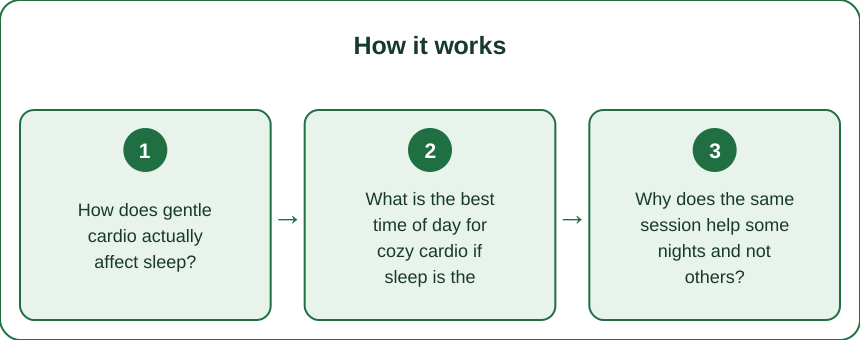
How does gentle cardio actually affect sleep?
Three separate things happen, and they run on different clocks.
The first is cortisol. Low-intensity movement in the evening tends to reduce circulating cortisol, whereas hard intervals raise it sharply for an hour or more. This is why a slow session helps sleep while a hard one at the same hour often does not — the intensity, not the exercise, is the variable.
The second is core temperature. Your body initiates sleep as core temperature falls. Any movement raises it slightly, then it drops below baseline afterwards, and that drop is a sleep signal. With gentle cardio the rise is small and the recovery fast — typically 60 to 90 minutes to get back to baseline and start falling. That number is the practical basis for timing advice.
The third is sleep architecture, which is the part people misunderstand. Regular light activity tends to improve sleep continuity — fewer wake-ups, faster return to sleep — more than it increases deep sleep. If you are tracking deep sleep on a wearable and expecting cozy cardio to push that number up, you will probably be disappointed while your actual sleep quality improves. The felt experience gets better before the metric does.
What is the best time of day for cozy cardio if sleep is the goal?
Two windows work well, and they work for different reasons.
Morning, within an hour of waking. This is the strongest option if your problem is falling asleep at a reasonable hour. Movement plus morning light anchors your circadian rhythm, and the effect shows up roughly 14 to 16 hours later as earlier sleep pressure. Nothing about the session needs to be hard. Twenty minutes on a walking pad while you drink coffee counts.
Evening, finishing 90 minutes before bed. This is the better option if your problem is a racing mind or restless legs rather than timing. The temperature dip lands right as you get into bed, and the movement gives an anxious nervous system something to do.
The window that causes trouble is the last 60 minutes before bed. Not because the movement is stimulating — at this intensity it is not — but because of everything that surrounds it: the overhead lights, the screen you are watching, the shower afterwards that spikes your temperature at exactly the wrong moment.
If your only available slot is right before bed, keep the movement and change the environment. One lamp instead of the ceiling light. No shower afterwards, or shower before instead. This single adjustment resolves the problem for most people who thought their evening session was the culprit.
Why does the same session help some nights and not others?
Because sleep responds to the whole day, and a twenty-minute session is a small input against a large background.
The usual confounders, in rough order of how often they matter: caffeine timing (a 2pm coffee still has roughly a quarter of its caffeine in you at 10pm), total daylight exposure (a day entirely indoors weakens every other sleep signal), alcohol (reliably wrecks the second half of the night regardless of what you did earlier), and evening light intensity.
There is also a late-summer specific factor worth naming, because it is live right now. As August turns towards September, evening light disappears noticeably earlier each week — in the northern US, sunset moves about 15 minutes earlier per week through late August and September. If you have been doing cozy cardio in natural evening light and it has quietly become artificial light without you noticing, your sleep may change for reasons that have nothing to do with the session.
The fix is to notice it deliberately rather than troubleshooting the workout. Shift the session earlier as the light does, or accept the lamp and dim it.
Myth vs Fact: cozy cardio and sleep
Myth: You need to be tired out to sleep well. Fact: Sleep drive comes from adenosine accumulation and circadian timing, not muscular fatigue. Plenty of exhausted people sleep badly. Gentle consistent movement often outperforms occasional hard sessions for sleep quality precisely because it does not spike arousal.
Myth: Any exercise before bed ruins sleep. Fact: The evidence for this is weaker than the folk wisdom suggests, and it mostly applies to vigorous exercise. Low-intensity movement close to bed is neutral to positive for most people. The environment around the session matters more than the session.
Myth: If your wearable does not show more deep sleep, it is not working. Fact: Consumer wearables estimate sleep stages from movement and heart rate and are meaningfully imprecise about stage classification. Continuity — total time asleep, number of awakenings — is measured far more reliably, and that is where light activity shows up first.
Myth: More is better. Fact: The sleep benefit plateaus quickly. Twenty to thirty minutes most days captures most of it. Pushing to 60+ minutes late in the evening starts adding heat and arousal without adding benefit.
FAQ: Cozy Cardio and Sleep Questions, Answered
How long before I notice a difference?
Most people report easier sleep onset within one to two weeks of consistent daily sessions. Changes in how rested you feel on waking usually lag by another week or so. If nothing has shifted after a month, the limiting factor is probably light exposure or caffeine rather than the movement.
Does it help with waking up at 3am?
Sometimes. Middle-of-the-night waking is more often linked to blood sugar, alcohol or stress than to activity level. Gentle evening movement can help by lowering pre-sleep arousal, but if the 3am waking is consistent and long-standing it is worth looking at your last meal and your alcohol intake first.
Is a walking pad better than a stationary bike for this?
Neither is inherently better. Walking has a slight edge for most people simply because it is easier to keep genuinely low-intensity — bikes tempt you into pushing resistance, which raises the arousal you are trying to avoid.
Should I stop if I feel more alert afterwards?
No — shift it earlier. Feeling alert after gentle movement usually means the session is landing in your natural evening alertness dip and pulling you out of it. Moving it 90 minutes earlier normally resolves this without losing the benefit.
This is general information, not medical advice. Persistent insomnia lasting more than three months deserves a conversation with a clinician rather than a schedule tweak.
TL;DR:
- Gentle cardio improves sleep mainly by lowering evening arousal and helping the post-session temperature drop — not by tiring you out.
- Best windows: within an hour of waking, or finishing about 90 minutes before bed.
- If you must move right before bed, keep the session and fix the lights and the hot shower — those are usually the real culprits.
- Expect better sleep continuity before you see any change in a wearable’s deep sleep number.
The reason cozy cardio and sleep pair so well is that neither one asks much of you. You are not trying to earn sleep through effort — you are giving a nervous system that has been sitting still all day a small, predictable signal that the day is winding down. Keep the session gentle, keep the room dim, and let the consistency do the work.
See It in Motion
Seen here: High Waist Wide Leg Yoga Pants with Pockets — shop it on bubblelime.com
Keep Reading
This article is for general informational and styling purposes only. Fit, sizing, and product availability may vary.